 Live
Live
FuscAuth
Centralized authentication service for the fuscripts ecosystem. Google and Microsoft OAuth, JWT tokens, shared commons packages, and the beginning of it all
Overview
Is an auth system really the best first step?
That question rattled around my head in late 2024. I had a vision for fuscripts — a connected ecosystem of productivity tools that felt like one unified experience. The kind of thing where you move between apps and it just works. But I hadn't built any of the apps yet. I was sketching the front door before there was a house.
I built it anyway.
November 10, 2024. That's the date on the first commit: "add initial google oauth poc." Three more commits followed that same day — refresh tokens, token verification, payload restructuring. FuscAuth was alive, at least in the way a proof of concept can be alive.
The tooling back then was a different world. I was using ChatGPT, but not integrated into my editor — just copying and pasting code between a browser tab and VS Code.
I was designing screens in Figma like it was 2019. But one thing felt genuinely new: I could generate images with ChatGPT.
Whimsy by design
I wanted every app in fuscripts to have personality. Not just functional screens — whimsical experiences. That started with the name itself.
I've always enjoyed making puns with my nickname (Fusca) and last name (Fuschini), so "FuscAuth" was low-hanging fruit that made me chuckle. I kept that naming convention for every project after — fusclock, fuscalendar, fuscorrespondence — and it still brings me a smile every time.
But a fun name wasn't enough. I wanted the login page to feel like something, not just a Google button on a white background. So I sat down with ChatGPT and brainstormed: how do you give an auth page personality? The logic clicked fast. An auth system controls who gets in. It grants permission to pass. That's a sheriff.

And once the Fusheriff existed, the rest of the world-building followed. If a sheriff guards the entrance to fuscripts, then fuscripts is a wild west land — a frontier full of possibilities and pioneering bugs. That metaphor stuck. It gave the whole ecosystem a vibe that made it feel less like a side project and more like a place.
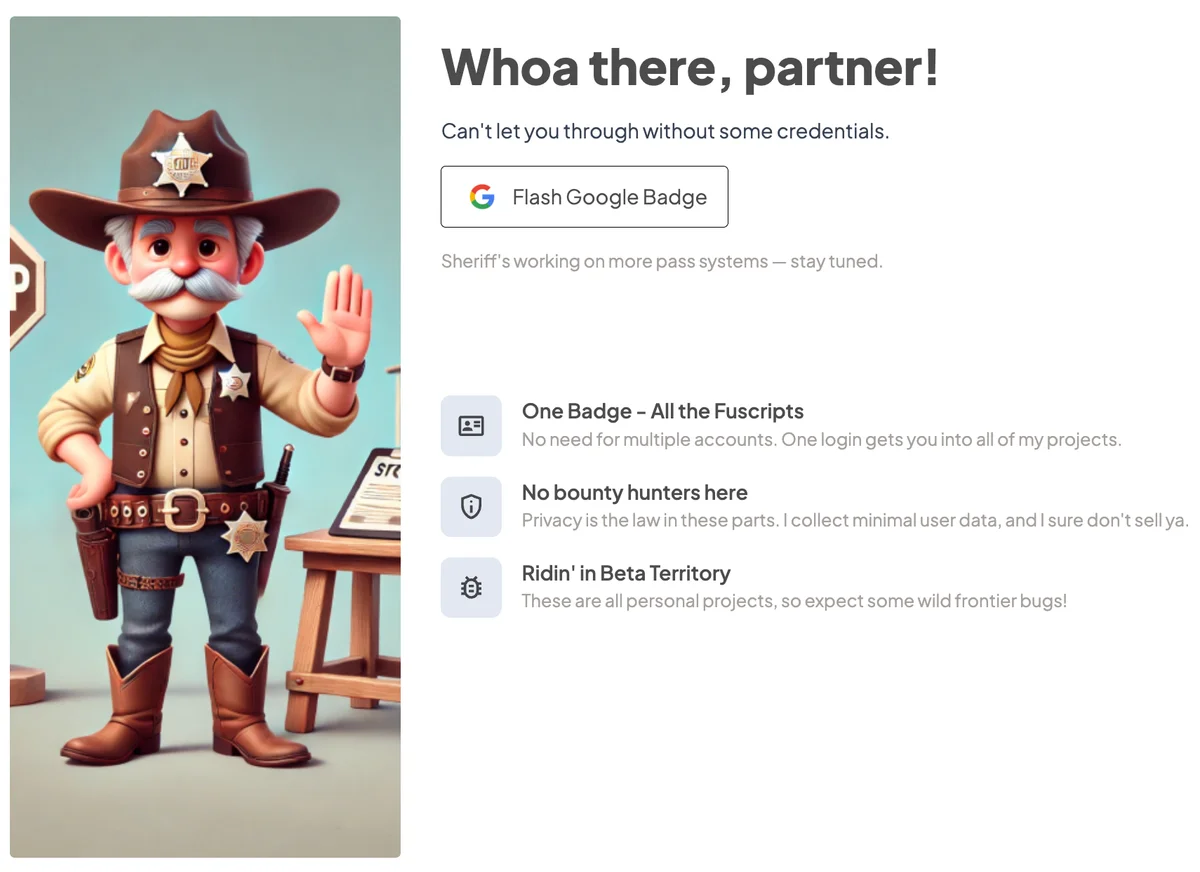
The scrappy v1
The initial implementation worked, but it wasn't pretty under the hood. Integrating any new app with FuscAuth meant copying and pasting auth code into the project. Every. Single. Time. And local development was a nightmare — Google OAuth didn't allow redirects to localhost, so testing the login flow meant deploying to the dev environment just to see if your changes worked. These were the kind of paper cuts that pile up quietly until you can't ignore them anymore.
It took months, but I eventually solved both problems. I built fuscauth-commons, a set of shared backend and frontend packages that any project can import instead of copy-pasting.
And I added a mock authentication mode that kicks in automatically during local development. No configuration needed. When deployed, it seamlessly applies the real auth logic. No risk of shipping mock auth by accident.
More than a login page
Here's the thing about FuscAuth that I didn't fully appreciate when I started it: the auth system was almost beside the point.
Before November 2024, it had been years since I worked on a personal project. I was deep in my career as a QA engineer and business analyst — working in tech, but not building things.
Not exercising that mad scientist muscle that gets fired up by bringing ideas to life.
FuscAuth changed that. It gave me momentum. One commit turned into four, which turned into a frontend, which turned into the next project, and the next. Today the fuscripts monorepo has over twelve projects, from time tracking to project management to voice-controlled development tools.
The other thing I didn't expect: building fuscripts kept me on the cutting edge of AI coding tools.
I went from copy-pasting ChatGPT output, to GitHub Copilot, to Claude Code. From OpenAI's models to Gemini to Claude. Each tool got a real workout because I had a real project to use it on. If I'd waited to experiment with these tools through work, I'd be significantly behind — AI adoption in established companies moves at a fraction of the speed of one person deciding to subscribe and start building.

None of the apps in the fuscripts ecosystem have real users yet. Maybe I could've gotten away with dummy auth for months. Maybe I would've refactored later. Or maybe — and this is the more honest scenario — I would've postponed that refactor indefinitely and still be dealing with fragmented login flows today.
I'll never know. What I do know is that building the front door first made the house feel real. And that was enough to keep building.